

Introduction
Tennis is a fantastic way to stay active, healthy and connected with others. In fact, one major long-term study found that people who played tennis had a life expectancy 9.7 years longer than those with a sedentary lifestyle. That’s certainly a good reason to keep playing!
Of course, all that gripping and hitting can sometimes take its toll – and tennis elbow is one of the most common problems we see in recreational players.clinic. While this condition can be frustrating, there is plenty you can do to manage it and keep active.
Frequently Asked Questions
Here are the most common questions that we receive regarding tennis elbow below.
Click on the questions to read our physiotherapists’ answers.
What is tennis elbow?
“Tennis elbow” is a common condition that causes pain around the outside of the elbow, at the point where a tendon attaches to the bone.
Tennis elbow often develops when the demands placed on the elbow increase beyond what the forearm muscles and tendons are currently used to.
Despite the name, you don’t have to play tennis to develop it – but repeated gripping and hitting can make tennis players particularly susceptible.
How will I know if I have tennis elbow?
Tennis players most often experience tennis elbow symptoms when gripping the tennis racket or hitting the ball.
It can also present in daily activities such as:
- lifting something with your arm outstretched, such as a full shopping bag;
- gripping or twisting, such as opening a jar or turning a door handle;
- doing repetitive activities with your hand or wrist, such as typing; or
- straightening your elbow, particularly after it has been resting.
The pain can sometimes travel a short distance down the forearm, and your grip may feel weaker than usual.
Why did I get tennis elbow?
Often there isn’t one single cause for tennis elbow.
Tennis elbow commonly develops when the amount or intensity of activity involving your arm increases faster than your forearm has had time to adapt.
For tennis players, this might happen after returning to tennis following a break, playing more often than usual, increasing the intensity or duration of your sessions, or playing several demanding sessions close together. Technique and racket set-up can also influence how much load goes through your elbow.
Activities away from the court matter too; gardening, DIY, manual work, gym training etc. can all add to the overall load on your elbow.
The useful thing to consider is not simply “what caused it?” but “what has changed recently?” Identifying a recent increase or change in activity can help you work out how to settle the elbow without necessarily having to stop doing the things you enjoy.
What can I do to help settle my tennis elbow?
You usually don’t need to stop using your arm completely. Instead, try to reduce the activities that are provoking it, while keeping the elbow active.
A few practical steps can help:
- Temporarily reduce the length, intensity or frequency of your tennis sessions.
- Avoid repeatedly pushing through increasing pain.
- Begin appropriate forearm strengthening exercises.
- Warm up your arm before playing.
- Spread demanding tennis sessions out where possible.
- Consider a tennis elbow strap if it makes activity more comfortable.
- Look at any recent changes in tennis volume, technique, racket set-up, gym training, work or other activities that may have contributed to the injury.
Can I keep playing tennis?
In many cases, yes. The aim is to find a level of tennis that your elbow can currently tolerate while you rebuild its strength.
Some mild discomfort during play can be acceptable. Pay attention to how your elbow feels later that day and the following morning. If it settles back to its usual level and isn’t gradually worsening, you may be able to continue playing.
If pain is increasing or you’re consistently worse afterwards, reduce the load for a while – for example, shorter or less intense sessions, fewer sessions per week, or temporarily avoiding the shots that aggravate it most.
Could my tennis technique be contributing to my tennis elbow?
Maybe. Hitting the ball late or off-centre, gripping the racket very tightly, or relying heavily on your arm rather than using your legs and trunk can increase the load on your forearm and elbow.
The backhand can be particularly provocative for some players. Consider asking a coach to assess whether your technique is placing unnecessary strain on your elbow.
Could my racket, grip or strings be affecting it?
Possibly. Racket set-up is unlikely to be the sole cause, but it can influence the forces your arm has to manage.
If you’ve recently changed your racket, grip or strings and symptoms appeared afterwards, consider having your set-up checked by an experienced coach or racket specialist. There isn’t one lighter, heavier or softer set-up that’s right for everyone.
Should I wear a brace or strap when playing?
A tennis elbow strap can reduce pain while playing for some people and make gripping and hitting more comfortable.
Don’t use a strap simply to push through significant or increasing pain. If you need it just to tolerate playing, or you’re consistently worse afterwards, reduce your tennis load and address the underlying problem.
What helps to heal tennis elbow?
The main aim is to manage the load on your elbow while gradually building its strength and capacity again. This usually involves:
- adjusting how much tennis and other gripping activity you are doing;
- gradually strengthening the forearm and wrist; and
- addressing contributing factors, such as technique or racket set-up.
Complete rest is rarely the answer. The goal is to keep the elbow active at a level it can tolerate, then gradually increase what it can cope with.
If symptoms are persistent or difficult to manage, a physiotherapist can assess the elbow and guide your rehabilitation.
What exercises should I do?
We have prepared a simple strengthening programme for recreational tennis players here.
The exercises are designed to gradually build the strength and capacity of your forearm and elbow. Start at a comfortable level and progress the resistance as you get stronger.
If the exercises cause significant or increasing pain, seek professional advice before progressing them.
How long will it take to get better?
Recovery varies. Some people improve considerably within a few weeks or months, while others can have symptoms for six months or longer.
Don’t be discouraged by occasional flare-ups – recovery isn’t always a straight line. Instead, look for progress over time: less pain, improving strength and being able to do more comfortably.
How do I prevent re-injury?
You can’t completely eliminate the risk, but keeping your elbow strong and managing your tennis load can reduce the risk.
Continue with your forearm strengthening exercises (overleaf) even after your symptoms have settled, gradually increasing the resistance (with heavier weights) as you get stronger.
Avoid sudden increases in frequency and intensity of play; build up gradually and consistently, always warm up before playing, and ensure sufficient recovery time between sessions.
General strength training can also help maintain the strength and capacity of your arm.
When should I go to see a physiotherapist?
We recommend that you seek a professional opinion if:
- your pain is persistent or worsening;
- your pain is limiting your tennis or everyday activities;
- you are unsure whether it is actually tennis elbow, or;
- you are finding it difficult to progress your rehabilitation on your own.
If your pain started after a significant injury, or you have marked swelling, significant weakness, numbness or tingling, it is important that you seek assessment from a chartered physiotherapist or doctor soon.
What can I expect from physiotherapy?
Physiotherapy can help you understand why your elbow is painful, what may be contributing to it and what you need to do to get back to comfortable tennis.
Your physiotherapist will assess your elbow, strength and movement, as well as the activities that aggravate your symptoms. From there, treatment is tailored to you.
Treatment usually includes a progressive strengthening programme, with exercises carefully selected and progressed to build your elbow’s ability to tolerate the demands of tennis.
Treatment may also include manual therapy to help reduce pain and improve movement. Depending on your symptoms and stage of recovery, other treatments such as shockwave therapy, laser therapy or dry needling may also be considered as part of your rehabilitation.
Just as importantly, your physiotherapist can help you decide how much tennis your elbow can currently tolerate and how to build back up safely, including addressing relevant training, technique or equipment factors.
Do you sell tennis elbow braces or supports?
Mid West Physiotherapy is an approved Donjoy fitting centre. We have a range of Donjoy braces and straps to support people with tennis elbow, with different options depending on your symptoms and needs. Please contact our clinic for more information.
How do I book a physiotherapy appointment?
You can book an appointment with any of our physiotherapists using our quick and easy online booking system.
Our physiotherapy team understands how frustrating it can be when an injury stops you playing the sport you enjoy. Our aim is to help you return to tennis confidently and safely, while reducing your risk of the problem returning.
If you have any questions about our tennis elbow injury guide, or if you’d like find out more out our services, please ring our Reception on 061-201444 or email info@midwestphysio.ie.
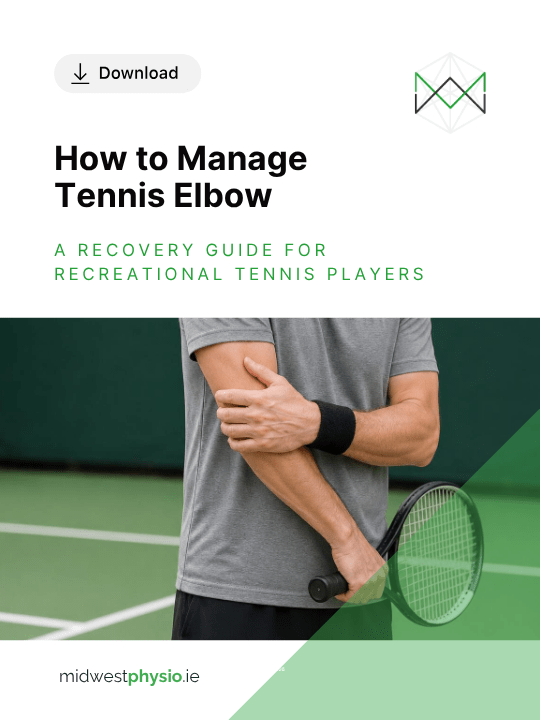
Free PDF Download
Our physiotherapy team at Mid West Physiotherapy, Castletroy, Limerick, has created this guide to give you clear, practical and evidence-based advice about tennis elbow.
We’ll explain what it is, why it happens, whether you can keep playing, what you can do to promote recovery, and how to reduce the chances of it coming back.
Most importantly, having tennis elbow doesn’t necessarily mean giving up tennis. With the right approach to activity, strengthening and recovery, many players can continue to enjoy the game while their elbow improves.
We hope you find the guide useful – and that it helps keep you on court!